
STMicroelectronics

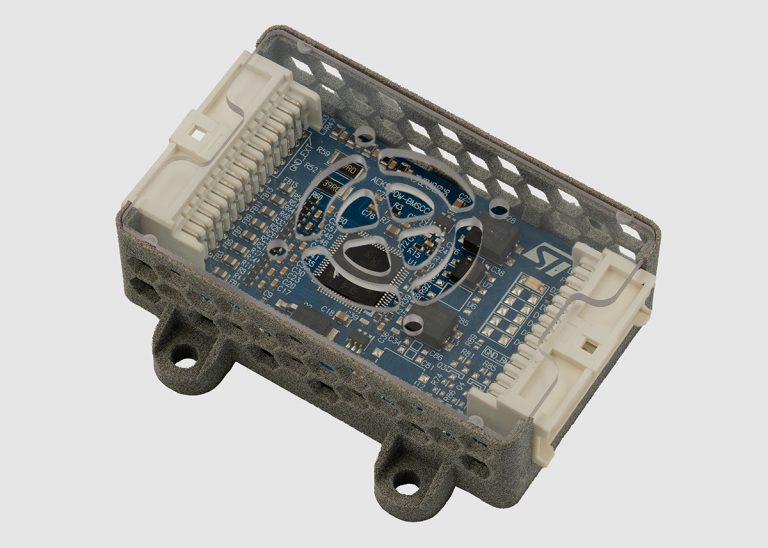
The EVLSPIN32G0A1 evaluation board from STMicroelectronics provides a hardware platform for assessing the STSPIN32G0A1 integrated motor-control system in three-phase brushless dc (BLDC) motor applications. 

The board operates from a supply range of 7V to 45V, and includes a power stage built from six STD140N6F7 MOSFETs which conduct up to 15Arms of continuous current. A three-shunt sensing topology is implemented to support high-performance field-oriented control and 6-step drive algorithms.

The board integrates voltage monitoring, PCB temperature sensing, an over-current comparator and under-voltage checks on driver supplies, enabling evaluation of the protection functions without external hardware. Digital Hall sensor and encoder inputs are provided for rotor position feedback, and bus voltage measurement is available for control loop implementation. 

The onboard regulators supply 3.3V and 12V rails for the integrated microcontroller and gate driver.

An embedded ST-LINK/V2-1 interface allows programming, debugging and UART communication through a Virtual COM port. User inputs include buttons and a potentiometer for speed and parameter adjustment during motor testing. When used with the STM32 Motor Control SDK, the board supports development and verification of control firmware for power tools, small appliances, fans, robotics and other low- to mid-power BLDC motor drives.

STMicroelectronics

The EVKITST87M01-2 evaluation kit from STMicroelectronics provides a hardware platform for assessing the behavior of the ST87M01-1001 and ST87M01-1301 NB-IoT modules in low-power asset-tracking and remote-sensing applications. The board exposes the module’s digital, analogue, and RF interfaces, allowing developers to characterize power consumption, network attach behavior, and positioning performance under controlled conditions.

The kit includes access points for monitoring power states such as PSM, eDRX, and wake-up events, supporting evaluation of battery-operated designs with long standby intervals. Standard Arduino Uno R3 headers allow connection to a wide range of microcontroller development boards, simplifying host-processor integration for early prototyping.

A companion software package enables network configuration, messaging tests, and logging of communication parameters. The board is suitable for early architectural decisions on asset-tracking tags, environmental nodes, and industrial sensing devices that require NB-IoT connectivity and long service life from compact enclosures.

Power Integrations

The RDR-1016 reference design board from Power Integrations implements a flyback converter which provides a dual isolated output voltage of 12V at 2A, and 5V at 500mA, from a wide input-voltage range of 85V to 265V ac. The power supply is based on the TNY5073K flyback converter, a member of the TinySwitch-5 family of ICs. 

The board achieves peak efficiency of at least 87% at full load with a 230V ac input. Average efficiency across the load range is at least 85%. 

The RDR-1016 conforms to the requirements of the CISPR22B/EN55022B standards for conducted EMI emissions. It is specified for operation at an ambient-temperature range of 0°C to 40°C with free-air convection cooling.

Renesas

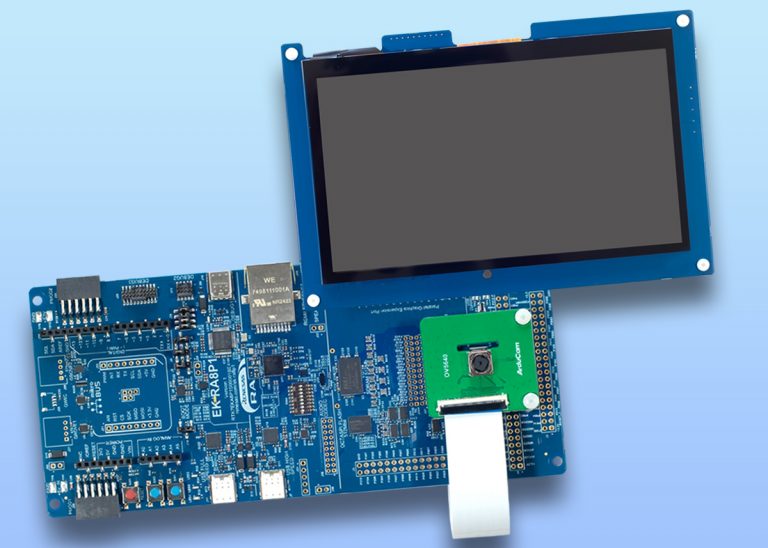
The MCK-RA8T2 development kit from Renesas is intended for evaluation of permanent-magnet synchronous motors (PMSMs) and other three-phase brushless loads driven by RA8T2 microcontrollers. The kit combines an RA8T2 CPU board (MCB-RA8T2), a low-voltage inverter board (MCI-LV-1), a PMSM, and accessories such as cables and stand-offs, so that engineers can exercise typical control schemes on a ready-made power stage.

An onboard debugger supports direct programming of the RA8T2 from a PC without an external probe. Connectors for Hall sensors, encoders and communication interfaces allow a range of feedback and host-control arrangements to be assessed. Sample code supports rapid bring-up, parameter tuning and waveform observation, helping developers to characterize the behavior of RA8T2-based control and networking operations in their intended industrial applications.

Key features include:

  • 1-, 2- and 3-shunt current sensing schemes for PMSM control
  • Integrated over-current and short-circuit protection
  • Supports Renesas Motor Workbench
  • Optional isolated communication via companion MC-COM board
  • Inverter board rated for operation up 48V
Littelfuse

The LEB-0024 evaluation board for the CPC1601M from Littelfuse includes on-board switches and a mode selector, allowing easy hands-on testing of the relay either manually or via external control signals. 

The kit features manual load switching via built-in tactile push-buttons, external control input pins for driving the relay from a microcontroller or logic, and a slide-switch to select an external supply or load-powered mode. The board includes a test pin to power external components up to 10mW, and over-voltage protection with a transient voltage suppression diode for the relay outputs.

The LEB-0024 board provides a ready-made platform to evaluate the CPC1601M latching and energy-harvesting capabilities.

STMicroelectronics

The X-NUCLEO-IKS5A1 integrates five sensors covering distinct measurement domains, bringing them into a single timing domain to simplify multi-sensor alignment and to support applications that require coherent motion, vibration, and environmental data. The solution includes:

  • ISM6GH256X intelligent IMU for simultaneous measurement of low-g and high-g acceleration 
  • ISM330IS six-axis IMU with always-on accelerometer and gyroscope 
  • IIS2DULPX ultra-low-power accelerometer
  • ILPS22QS barometer with 1260hPa and 4060hPa ranges
  • IIS2MDC three-axis magnetometer 

The platform makes these industrial sensors accessible to developers using an STM32 microcontroller through its Nucleo-compatible interface and the ST software ecosystem. Onboard features such as sensor hub support, finite state machines, and machine learning cores allow initial data processing directly at the sensor, reducing the computation workload on the host processor. The ST MEMS-Studio and X-CUBE-MEMS1 software support configuration, acquisition control, and parameter visualization for simplified development and analysis.

Detachable add-on modules provide additional connectors, and support distributed sensing layouts for either the STEVAL-MKGI07A microcontroller board or the main X-NUCLEO-IND5A1 board.