

Intelligent IMU detects low-g and high-g events simultaneously
The ISM6HG256X sensor module from STMicroelectronics can be used to track both slow-motion events, such as the tilting of a display user interface, and fast events such as shock or impact.
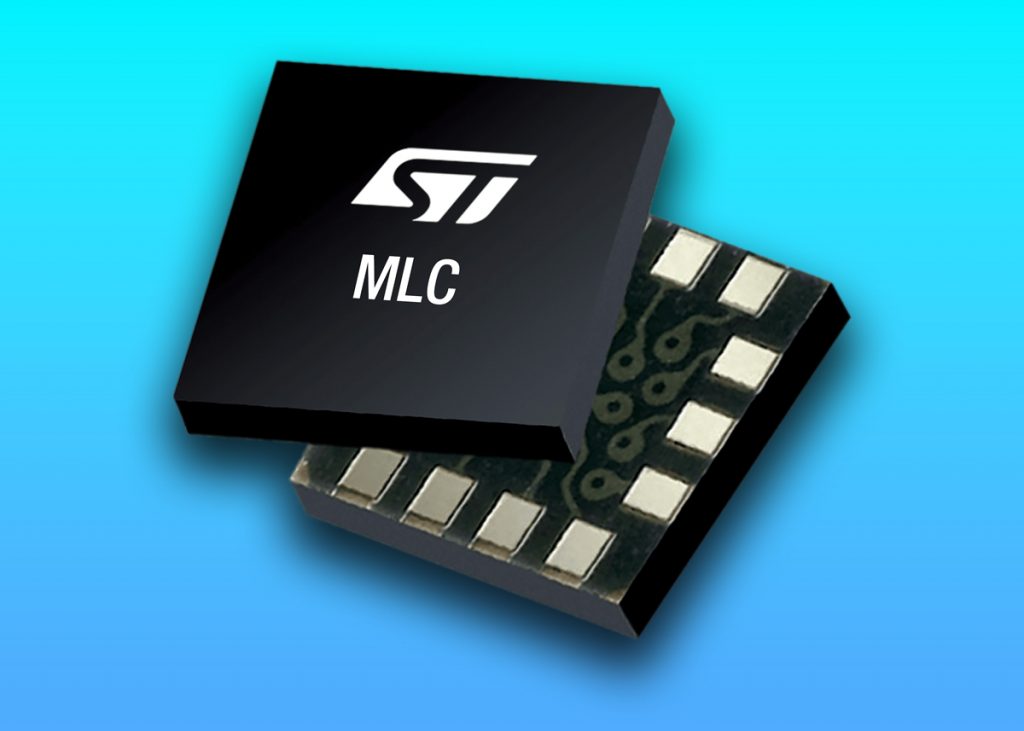
The ISM6HG256X is a low-noise and low-power six-axis inertial measurement unit (IMU) containing dual three-axis accelerometer channels dedicated to the measurement of low-g and high-g forces, as well as a three-axis gyroscope with extended selectable scales. Both accelerometer channels record signals at the same time, removing the need to add a second sensor to measure fine motion and shock events simultaneously.
The outputs from the ISM6HG256X are configured in four channels, with dedicated configuration, processing, and filtering circuits for each channel. Channel 1 is for user interface applications, supporting data processing for motion tracking. In this mode, the accelerometer and gyroscope have independent output data rates and full-scale ranges.
Channel 2 is for optical image stabilization. The accelerometer has a full scale of ±2g to ±16g, and the gyroscope, ±250 degrees/s to ±4,000 degrees/s.
Channel 3 is for enhanced electronic image stabilization. Data are available in free-run mode in the output registers, or in a FIFO with dedicated tag and timestamp.
Channel 4 is for high-g applications such as shock detection, here the accelerometer processes motion data across a full-scale range of ±32g to ±256g.
On-sensor intelligence reduces the data processing burden on the host controller. A programmable finite state machine recognizes motion patterns, and a machine-learning core implements algorithms in the sensor itself through a set of configurable parameters and decision trees. Algorithms implementing a pedometer, tilt detection and motion detection are ideal for smart robotics and automation applications.
The sensor can re-tune itself using embedded adaptive self-configuration, switching ranges, bandwidths or functions when conditions change, without intervention from the host. A low-power sensor fusion algorithm enables orientation-aware behavior even when the host is asleep. FIFO data buffering with compression and timestamps batches data so the host wakes only when needed.