

Power management ICs provide single-chip solutions for PoE
The PD77020 power controller and PD77728 power manager from Microchip provide highly integrated solutions for power-over-Ethernet (PoE), giving designers an easy way to implement the technology while reducing board footprint.
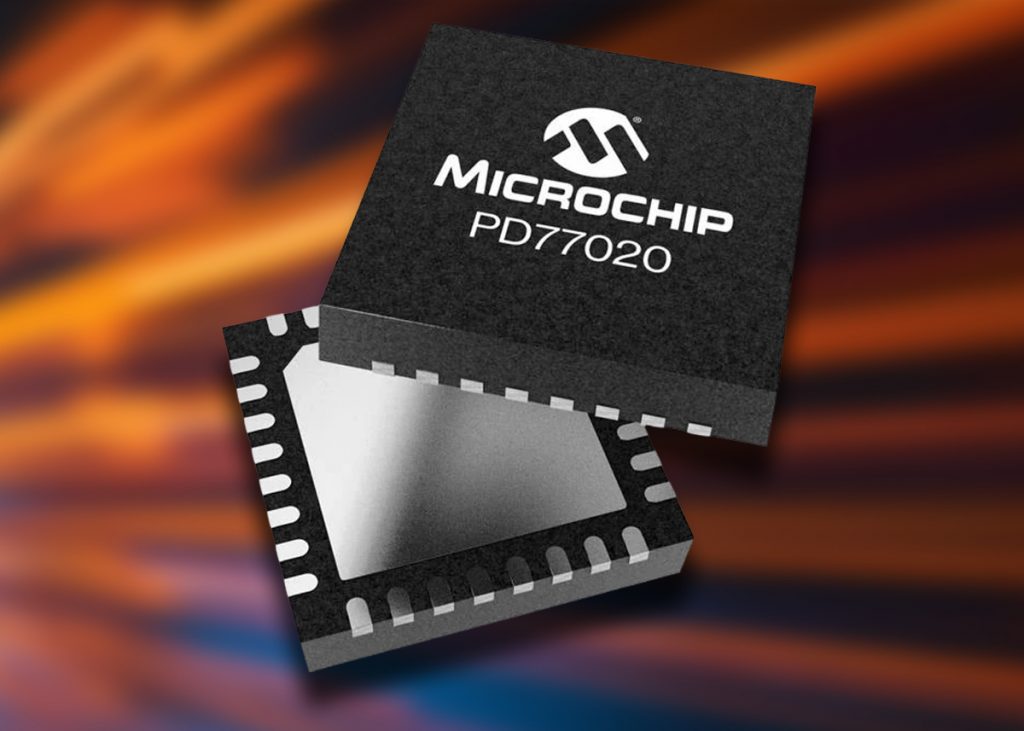
Part of the seventh generation of Microchip power-sourcing equipment (PSE) technology for PoE applications, the PD77020 is a PSE controller and the PD77728 is a PSE manager.
These power management ICs are highly integrated, energy-efficient and surge-protected designs supplied in a compact form factor. The only external component required is a capacitor, helping PoE system designers to save board space and reduce bill-of-materials costs.
The PD77020 power controller is typically used in conjunction with up to 12 PD77728 power managers to create a complete PSE system, in which the PD77020 provides high-level, sophisticated, and multi-port PoE functions, such as port mapping Port Matrix, port priority, port status, and system power management.
PSE controllers and managers are widely implemented in various Ethernet networking devices, including switches, routers and gateways, as well as in specialized equipment such as digital video recorders and PoE midspans/injectors.
PoE enables the transmission of both power and data over a single Ethernet cable. Networking devices such as Ethernet switches, routers and gateways supply power through a PSE chip embedded within the unit. Devices powered by PoE, such as wireless access points, incorporate a powered device (PD) IC to receive this power. These two components work together to deliver power to connected devices via the Ethernet cable.
Power delivery does not commence until the PD requests it. There are eight power classes and the PD specifies the exact amount of power required, ranging from as little as 4W up to 90W at the source.
On receiving a valid power request, the PSE acknowledges and classifies the requested power before initiating delivery. Both the PSE and PD continuously monitor for faults to protect the devices. If a fault is detected, or if the device no longer requires power, the PSE will terminate power delivery.