
Infineon

The OPTIGA Authenticate NBT development kit from Infineon is ideal for the quick and simple evaluation of the OPTIGA Authenticate NBT using example applications available through GitHub. These example applications include code for smartphones based on the Android or iOS operating systems.

The kit simplifies the development of custom applications using a PSOC host microcontroller based on the example applications. After detaching the adaptor board, the shield may also be used separately for evaluation and application development using other MCU boards.

STMicroelectronics

The P-NUCLEO-53L8A1 from STMicroelectronics is a complete evaluation kit for learning about, evaluating, and developing applications with the VL53L8 series of direct time-of-flight (ToF) sensors.


Microchip

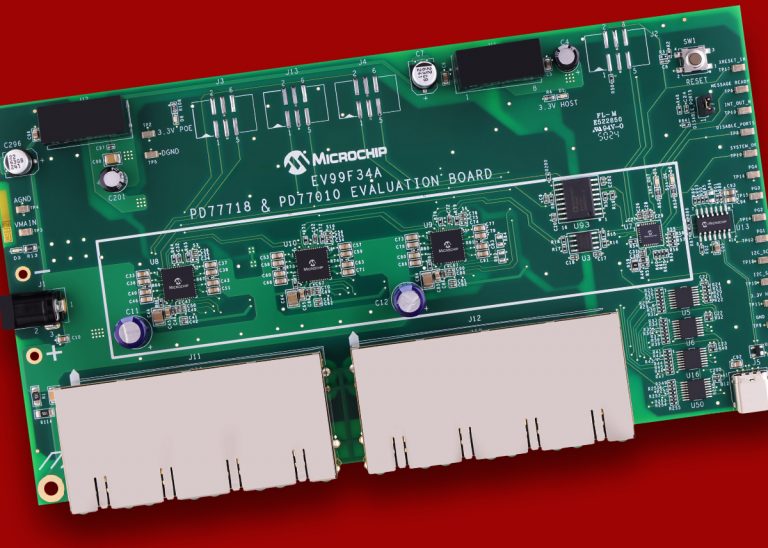
The EV99F34A evaluation board from Microchip is based on its PD77718 power-over-Ethernet (PoE) manager and PD77010 PoE controller. 


Operating in controller mode using the PD77010, the EV99F34A board demonstrates eight IEEE 802.3bt 2-pair ports using the PD77718T3, and eight IEEE 802.3bt 4-pair ports using two PD77718T4 devices. The evaluation system provides designers with a suitable environment for evaluating the performance and implementation of these PoE managers and controller. The firmware supplied by Microchip supports both 4-pair and 2-pair operation. 

Key features: 

  • IEEE 802.3af/at/bt Type 4 standard compliant
  • Switch-domain USB-C® interface to be connected to a PC with Microchip GUI
  • PoE controller manual reset and disable ports
  • LED status indication for all ports 
  • Single power source 
  • Operating-temperature range: 0°C to 40°C
STMicroelectronics

The X-NUCLEO-DRP1M1 expansion board from STMicroelectronics enables designers to evaluate the features of the TCPP03-M20 USB Type-C® Power Delivery (PD) controller, including the ability to protect the bus- and supply-voltage lines in dual-role power (DRP) applications.

The expansion board can be stacked on top of any STM32 Nucleo-64 board which has a USB PD peripheral embedded in its microcontroller.

The X-NUCLEO-DRP1M1 demonstrates dead battery and sink operations, an integrated ST715PU33R linear regulator supplies the associated STM32 Nucleo development board. It also performs USB Type-C source operations when a compatible external source is connected to the board. In addition, the board supports dual role data functionality for sourcing devices.

The X-NUCLEO-DRP1M1 complies with the USB Type-C and USB PD 3.1 specifications for the standard power range, and is USB-IF certified as a 100 W DRP solution supporting a programmable power supply.

The companion X-CUBE-TCPP software package contains application examples for NUCLEO-G071RB and NUCLEO-G474RE development boards. These can be ported to other development boards that have USB Type-C PD-enabled MCUs.

STMicroelectronics

The STM32 Nucleo-64 board for the STMicroelectronics STM32U3 series of ultra low-power microcontrollers provides an affordable and flexible way for users to try out new concepts and build prototypes.


STMicroelectronics

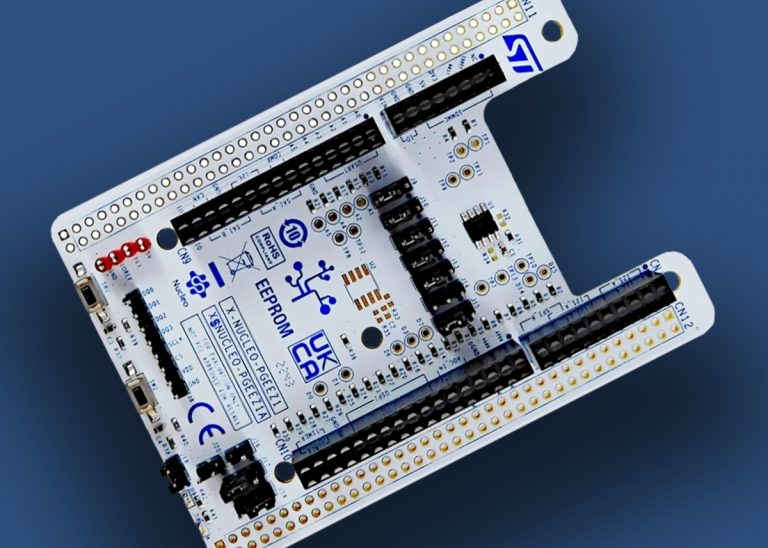
The X-NUCLEO-PGEEZ1 expansion board provides an evaluation platform for the M95P32 series SPI page EEPROM memory. This expansion board enables developers to evaluate the EEPROM’s performance via a single/dual/quad SPI interface.

STMicroelectronics

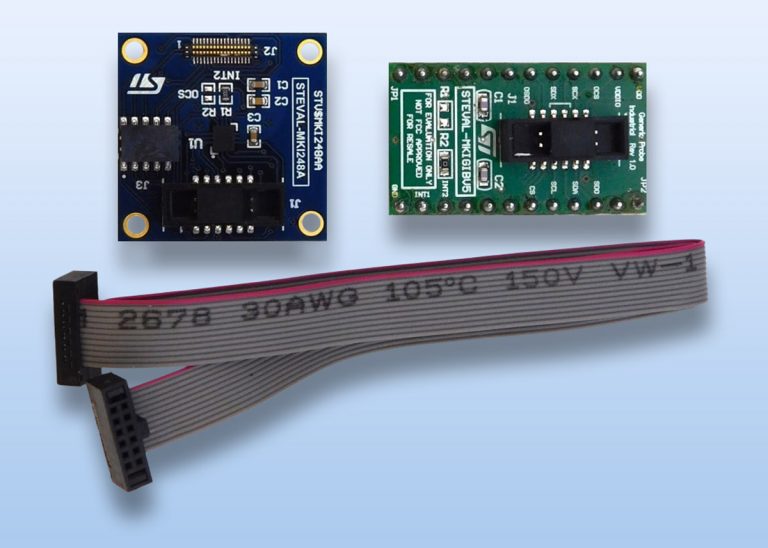
The STEVAL-MKI248KA kit from STMicroelectronics consists of a generic DIL24 adapter board, the STEVAL-MKIGIBV5, a flat cable, and a square PCB on which is mounted the ISM6HG256X six-axis IMU.

The sensor is soldered precisely in the center of the square PCB, making it easy to mount the board on prototype equipment.

STEVAL-MKIGIBV5 board can be plugged into a standard DIL-24 socket. The kit supports the complete ISM6HG256X pin-out, and comes ready to use with the required decoupling capacitors on the power-supply line.

The kit is complemented by the STEVAL-MKI109D evaluation platform, which includes a high-performance 32-bit microcontroller: this functions as a bridge between the sensor and a PC, on which engineers can use the downloadable MEMS Studio graphical user interface, or dedicated software routines for custom applications.