

Single-chip MCU combines capacitive sensing with system control for HMI designs
The Infineon Technologies PSoC™ 4100T Plus integrates fifth-generation CAPSENSE™ and Multi-Sense technology with an Arm® Cortex®-M0+ core, allowing designers to consolidate touch sensing and general-purpose control on a single device.
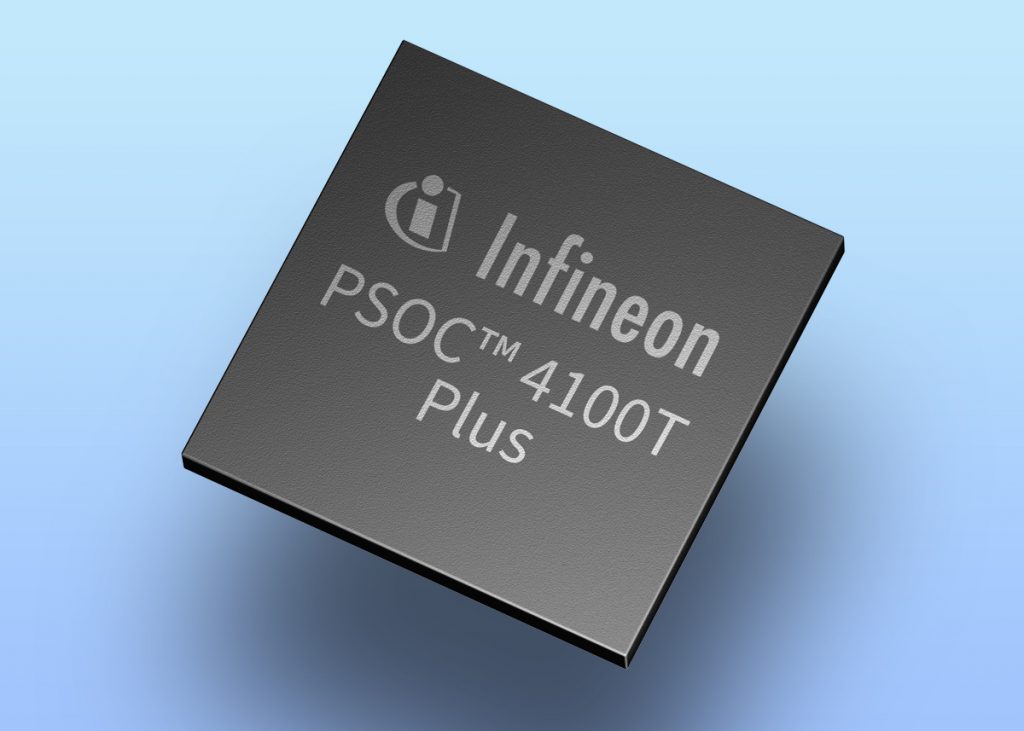
Many human-machine interface (HMI) designs require a dedicated touch controller alongside the main MCU, adding board area, bill of materials cost, and inter-device communication overhead. The PSoC 4100T Plus removes that requirement by combining a 48MHz Arm Cortex-M0+ processor with the Infineon fifth-generation CAPSENSE and Multi-Sense technology on a single die, with up to 32 sensor inputs available simultaneously across all sensing modes.
The CAPSENSE implementation supports both self-capacitive and mutual-capacitive touch detection, covering finger touch and proximity sensing for standard panel applications. Beyond conventional touch, the Multi-Sense subsystem extends capability to inductive sensing, which allows detection over metallic surfaces. A feature that is useful in appliances and industrial panels where a protective metal fascia is required. Liquid level sensing and CAPSENSE hover touch for proximity and gesture detection are also supported, giving designers a broad set of sensing options without adding external components.
Signal integrity in real-world environments is a practical concern for any touch interface. The fifth-generation CAPSENSE architecture delivers a high signal-to-noise ratio and liquid tolerance, allowing panels to remain functional when wet. This is relevant for white goods, outdoor controls, and wearables where condensation or splashing is likely. The PSoC 4100T Plus also offers three times the electrostatic discharge robustness compared to earlier PSoC 4 MCUs, reducing the risk of field failures in consumer and light industrial products.
Power management is addressed at the hardware level. In deep sleep mode, touch sensing continues autonomously, with the processor waking only on a valid touch event. This hardware-based wake-on-touch approach avoids the need for software polling, keeping average current consumption low in battery-operated or mains-powered products where the interface must remain responsive over extended periods.
The 1% internal main oscillator clock accuracy option supports synchronous serial communication without an external crystal, simplifying board design. The peripheral set includes six 16-bit timer/counter/PWM blocks, a 12-bit 1Msample/s ADC with an eight-channel sequencer, two serial communication blocks configurable as I2C, SPI, or UART, and three additional UART blocks. This combination makes the PSoC 4100T Plus capable of acting as a complete system controller, handling both HMI and application logic in a single device. Infineon’s ModusToolbox software supports the device with board support packages, a peripheral driver library, and CAPSENSE middleware, reducing firmware development effort.