
Renesas

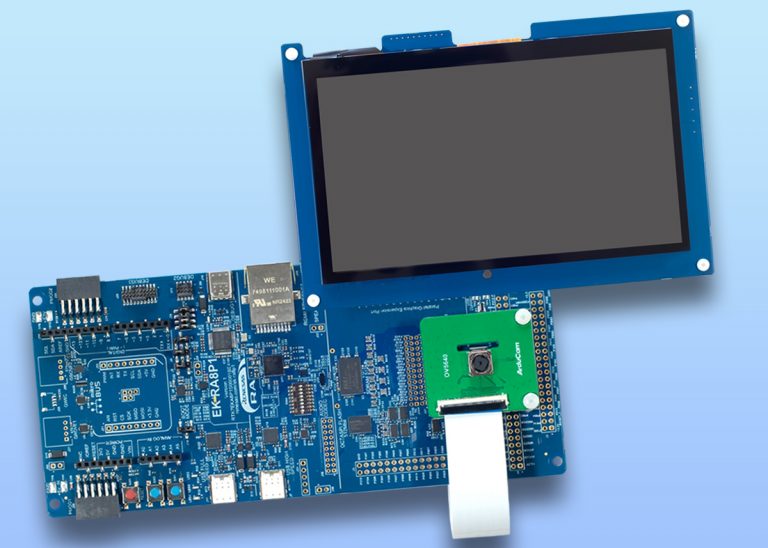
Renesas offers the EK-RA8P1 evaluation kit to support development with the RA8P1 MCU. This kit includes an RA8P1 board with on-board J-Link debugger and connectors for Ethernet, USB, audio, and displays, plus a 7-inch capacitive-touch LCD and 5MP camera module for human-machine interface and vision demos.

The EK-RA8P1 comes pre-loaded with example projects showcasing the MCU 1GHz performance in voice recognition, image capture, and real-time analytics, allowing engineers to rapidly evaluate RA8P1 features using the Renesas FSP middleware and e²Studio IDE.

Infineon

AI evaluation kit targets inference and always-on workloads on PSOC™ Edge E84

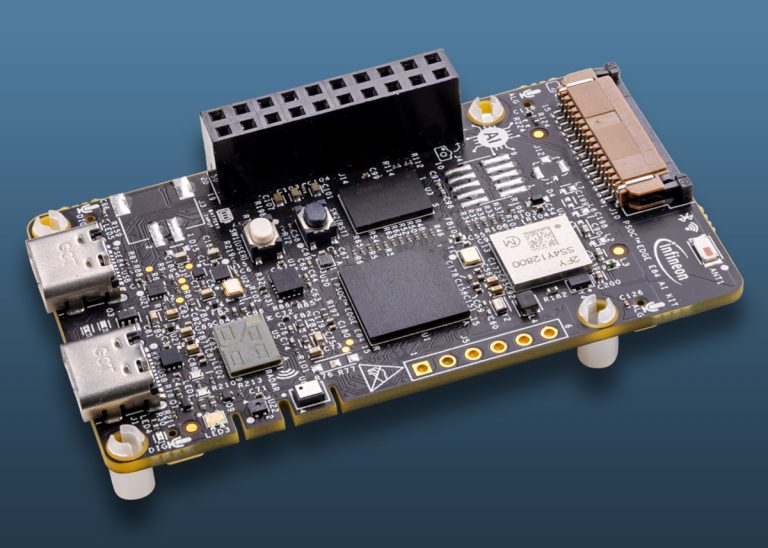
The KIT_PSE84_AI evaluation kit is intended for assessment of artificial intelligence and machine learning workloads on the Infineon PSOC™ Edge E84 microcontroller. The board is configured to demonstrate the interaction between the high-performance compute domain, based on the Arm® Cortex®-M55 with Ethos™-U55 NPU, and the low-power always-on domain, which combines a Cortex-M33 core with Infineon’s NNLite neural network accelerator.

The platform supports evaluation of common edge AI use cases such as acoustic activity detection, voice processing, and sensor-based inference. Audio interfaces, sensor connectivity, including 60GHz radar and pressure sensors as well as memory access are provided to allow execution of neural network models across shared SRAM and non-volatile RRAM resources. This enables analysis of task partitioning, power-domain interaction, and inference latency under representative operating conditions.

The kit is supported by the ModusToolbox™ development environment and integrates with DEEPCRAFT™ Studio tooling for model deployment and validation. It is intended for engineers evaluating AI-enabled embedded architectures where low-power, always-on inference and higher-performance processing must operate within a single device.

Infineon

Evaluation board supports AI and HMI development on PSOC Edge E84

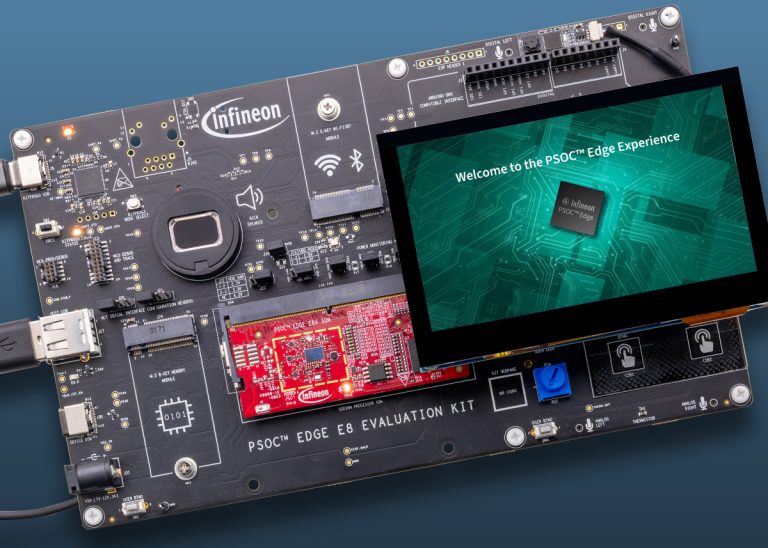
The KIT_PSE84_EVAL evaluation board provides a hardware platform for assessing the capabilities of the Infineon PSOC Edge E84 microcontroller in AI-enabled embedded systems. The board exposes both the high-performance and low-power compute domains, allowing evaluation of workloads that combine neural network inference, signal processing, and real-time control.

The evaluation board supports development of always-on AI use cases by enabling interaction between the Cortex®-M55 with Ethos™-U55 NPU and the low-power Cortex-M33 with NNLite accelerator. Memory resources are accessible to demonstrate shared SRAM and non-volatile RRAM usage across compute domains. Interfaces for audio, display, sensors, and communication peripherals allow investigation of voice, graphics, and HMI workloads under representative system conditions.

Debug and programming interfaces support firmware development and analysis using the ModusToolbox™ software environment, with compatibility for AI workflows using DEEPCRAFT™ Studio. The board is intended for evaluation of edge AI, low-power inference, and multi-core task partitioning in consumer, industrial, and security-focused applications.

Infineon

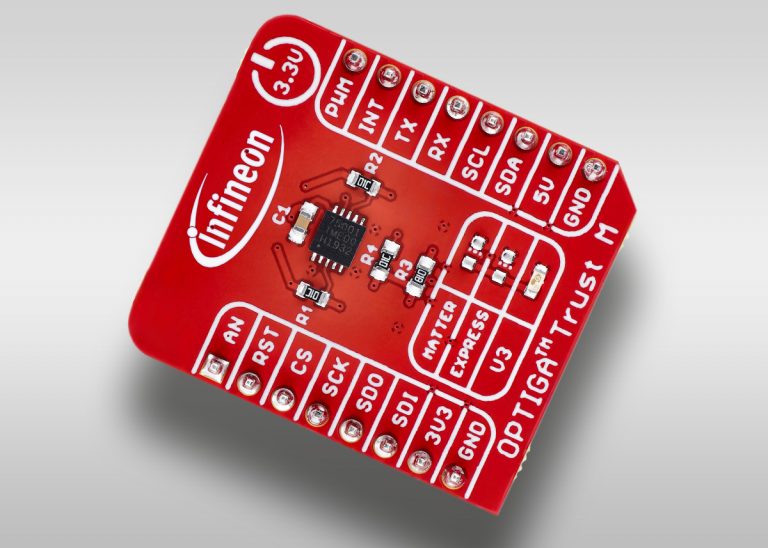
The OPTIGA™ Trust M Express Shield from Infineon provides a convenient way to evaluate the OPTIGA Trust M Express family of discrete secure elements. 

It is supplied in a popular mikroBus™ format which makes it easy to integrate into prototype systems based on any microcontroller or microprocessor platform. The shield board can also be used with single-board computers when supported by the appropriate adapters. 

The OPTIGA Trust M Shield is compatible with the Infineon PSOC™ 62S2 Wi-Fi BT Pioneer Kit and OPTIGA Trust Adapter.

Features of the shield board include:

  • Pre-provisioned TLS security certificates
  • CC EAL 6+ certified hardware
  • Qwiic compatible
  • I2C interface with shielded connection
  • Cryptographic toolbox
  • Supports multiple cryptographic algorithms:

ECC, RSA, AES, HMAC, HKDF, TLS PRF

Renesas

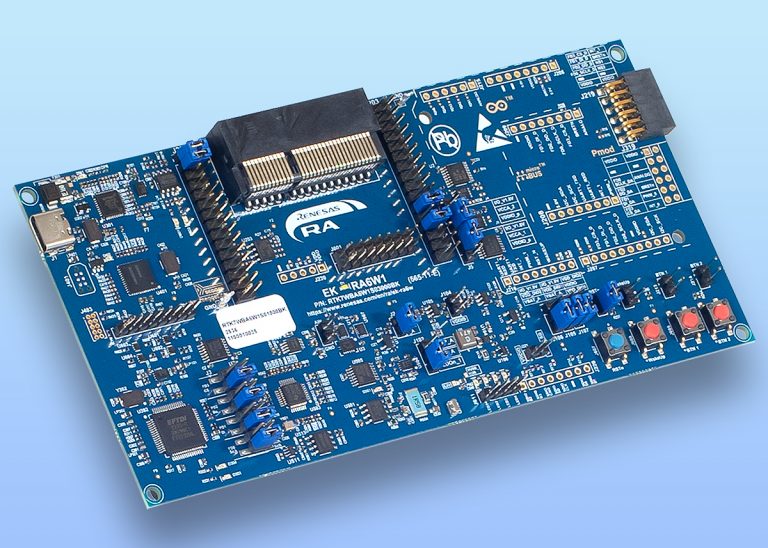
The EK-RA6W1 comprehensive development kit features a main board and daughter card to provide easy software application development, with tools and resources to simplify the writing and testing of code.  Radio frequency (RF) testing is supported, allowing developers to measure and optimize performance, and to evaluate integration with cloud services.

A unique feature of this kit is the integrated power profiler circuit, which enables power consumption measurements during low-power sleep with precision down to 1µA. To support full software application development and system validation, the EK-RA6W1 offers multiple expansion options, including mikroBUS, Pmod, and Arduino UNO connectors. These standardized interfaces make it easy to add sensors, displays and more to EK-RA6W1.

STMicroelectronics

The EVLSPIN32G0A1 evaluation board from STMicroelectronics provides a hardware platform for assessing the STSPIN32G0A1 integrated motor-control system in three-phase brushless dc (BLDC) motor applications. 

The board operates from a supply range of 7V to 45V, and includes a power stage built from six STD140N6F7 MOSFETs which conduct up to 15Arms of continuous current. A three-shunt sensing topology is implemented to support high-performance field-oriented control and 6-step drive algorithms.

The board integrates voltage monitoring, PCB temperature sensing, an over-current comparator and under-voltage checks on driver supplies, enabling evaluation of the protection functions without external hardware. Digital Hall sensor and encoder inputs are provided for rotor position feedback, and bus voltage measurement is available for control loop implementation. 

The onboard regulators supply 3.3V and 12V rails for the integrated microcontroller and gate driver.

An embedded ST-LINK/V2-1 interface allows programming, debugging and UART communication through a Virtual COM port. User inputs include buttons and a potentiometer for speed and parameter adjustment during motor testing. When used with the STM32 Motor Control SDK, the board supports development and verification of control firmware for power tools, small appliances, fans, robotics and other low- to mid-power BLDC motor drives.

1 2 3 28