
Allegro Microsystems

Allegro MicroSystems evaluation boards simplify the evaluation process for its tunnel magnetoresistance (TMR) current sensors. The boards provide test points for convenient access to device pins, allowing for quick measurement and validation without the need for complex test set-ups. 

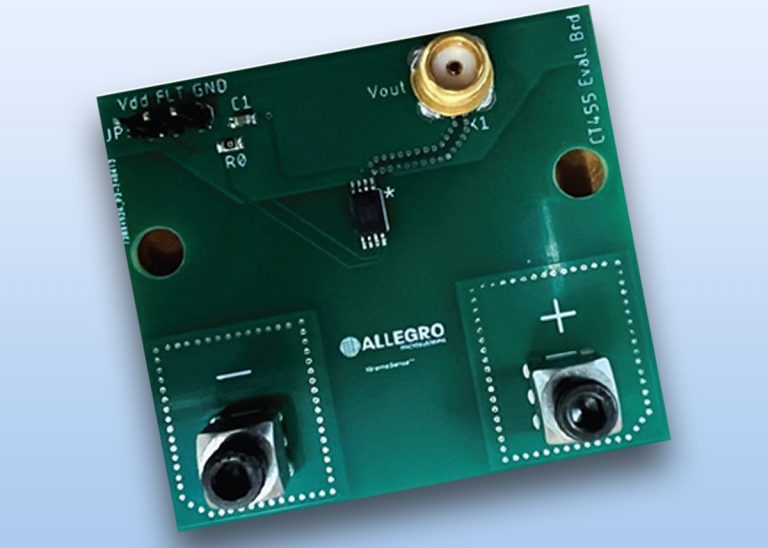
The CTD455-BB-48B5 board provides a simple way to evaluate the performance of the CT455 XtremeSense™ TMR current sensor. The CT455 on the board senses and translates the magnetic field into a linear analog output voltage. The current sensor achieves a total error output of less than 1% over voltage and temperature. 

Key features:

  • Preset magnetic field range: ±6 mT or ±48 mT
  • Low-noise performance
  • Optimized for high dV/dt applications
  • Less than 300 ns response time
  • 5 V supply voltage
  • Operating-temperature range: -40°C to 125°C
STMicroelectronics

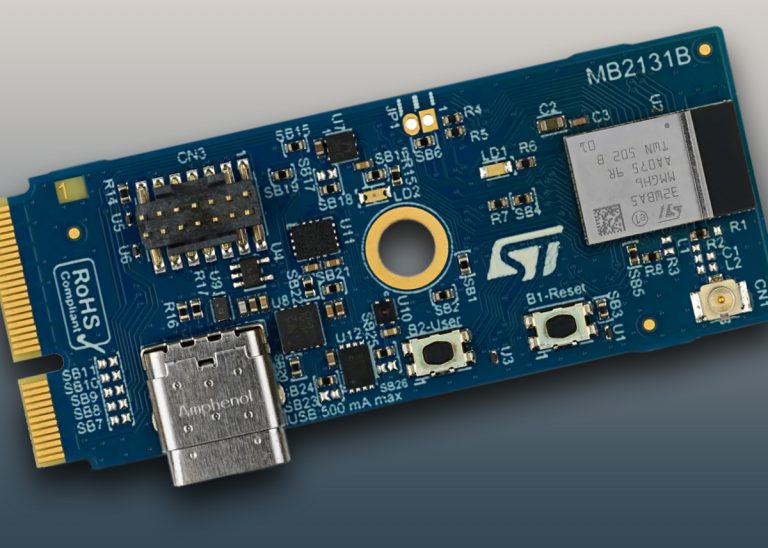
The B-WBA5M-WPAN STM32WBA connectivity expansion board from STMicroelectronics provides a flexible way to evaluate the STM32WBA5MMGH6 module.

The board includes a USB Type-C® connector for power only. It also integrates an M.2 E‑Key connector, turning it into an M.2 E‑Key daughterboard which provides a Bluetooth® interface to a host board that has an M.2 E‑Key host connector. The M.2 E‑Key connector is compatible with the PCI-SIG standard, and provides UART, SPI, I2C, and SAI interfaces for communication with the host.

The B-WBA5M-WPAN board is supported by the STM32CubeWBA software package. 


Key features include: 

  • 256 kbit serial EEPROM
  • Accurate MEMS temperature sensor
  • 3D accelerometer and 3D gyroscope
  • User LED
  • User and reset push buttons
Allegro Microsystems

Allegro MicroSystems evaluation boards simplify the evaluation process for its tunnel magnetoresistance (TMR) current sensors. The boards provide test points for convenient access to device pins, allowing for quick measurement and validation without the need for complex test set-ups. 

STMicroelectronics

The EVLVIPGAN100PD from STMicroelectronics is a 100 W USB Power Delivery (PD) 3.0 reference design for a USB Type-C® power adapter. 

It is an isolated power supply with a stand-alone USB PD controller. The evaluation board implements, at the primary side, a quasi-resonant flyback converter based on the ST VIPERGAN100, high-voltage flyback converter with optocoupler feedback for voltage regulation and a high-voltage gallium nitride (GaN) power switch. 

The converter combines a high-performance, low-voltage PWM controller chip with a 650 V start-up cell in a single package. The reference design achieves low standby power consumption thanks to the VIPERGAN100’s advanced power management and low quiescent current. 

To reduce the input mains current distortion, a power factor correction circuit based on the L6564 controller IC is used. At the secondary side, to increase system efficiency, rectification is based on the SRK1001 adaptive synchronous rectification controller.

The reference design also includes an STUSB4761 controller, which offers the benefits of a full hardware USB PD stack, allowing for robust, deterministic, and safe negotiation in line with USB PD standards.

STMicroelectronics

The STM32 Nucleo-64 board for the STMicroelectronics STM32U3 series of ultra low-power microcontrollers provides an affordable and flexible way for users to try out new concepts and build prototypes.


STMicroelectronics

The EVLSTGAP3S6S is a half-bridge evaluation board for evaluating the STGAP3S6S isolated single gate driver from STMicroelectronics.

The STGAP3S6S features a maximum 6 A current capability, rail-to-rail outputs, and optimized under-voltage lockout and desaturation protection thresholds for silicon carbide (SiC) MOSFETS. It is ideal for use in high-power industrial motor drivers.

The gate driver has a single Output pin and a driver line for an external Miller clamp N-channel MOSFET: this optimizes the suppression of positive and negative gate spikes during fast commutations in half-bridge topologies.

Device protection features are connected to the recommended network on the board and can be easily evaluated through the board test points. Dual Input pins allow the selection of signal-polarity control and hardware interlocking protection to avoid cross-conduction in case of controller malfunction.

The gate driver allows negative gate driving, and the onboard isolated dc-dc converters provide an optimized drive voltage for SiC MOSFETs.