
Power Integrations

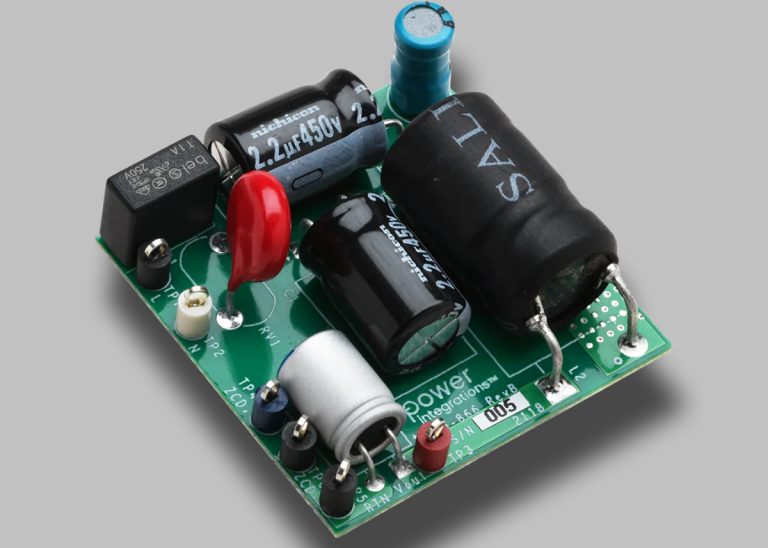
The RDK-866 reference design describes a non-isolated buck converter power supply with an input-line zero-crossing detection output signal. The nominal output is 5 V/500 mA across the input range of 90 V to 300 V ac. 

The system is powered by the LinkSwitch-TNZ IC controller. The LinkSwitch-TNZ family of ICs combines power conversion with lossless generation of an ac zero-crossing signal used typically for system clock and timing functions. The device incorporates a 725 V power MOSFET, oscillator, a high-voltage switched current source for self-biasing, frequency jittering, fast (cycle-by-cycle) current limit, hysteretic thermal shutdown, and output and input overvoltage protection circuitry in a monolithic IC. 

Designs using the highly integrated LinkSwitch-TNZ ICs are more flexible than discrete implementations, reducing component count by 40% or more. The key design goal is low cost, low audible noise and compact form factor for use in wireless and relay power supplies.
STMicroelectronics

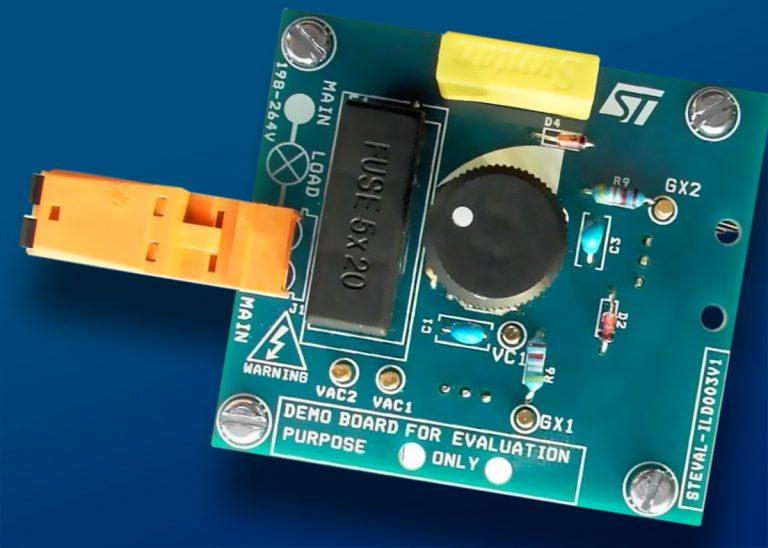
The STEVAL-ILD003V1 demonstration board implements a low-cost analog dimmer using the TS820-600FP, a sensitive-gate silicon-controlled rectifier (SCR) thyristor. The dimmer can drive typical low-power lamps such as compact fluorescent or dimmable LED lights.

Through-hole technology is used for the most important components, such as an LC filter, gate resistor, and turn-on delay capacitor, to allow for modification of the board.

The STEVAL-ILD003V1 eliminates flickering thanks to its continuous current applied through the sensitive SCR gate. This dimmer could easily replace a standard low-cost analog triac light dimmer using a diac-controlled circuit.

The STEVAL-ILD003V1 is for use in Europe at a mains voltage of 220 V. A 110 V version, the STEVAL-ILD003V2, is for use in North America. 

Key features:

  • For 2-wire wall dimmers
  • Leading-edge control compatible with all lamp types commonly found on the market
  • Dimmable power range: 3 W to 350 W 
  • 60°C maximum ambient temperature 
  • Higher than 99% power efficiency at 350 W/230 V
  • Less than 0.5 W standby power losses
Infineon

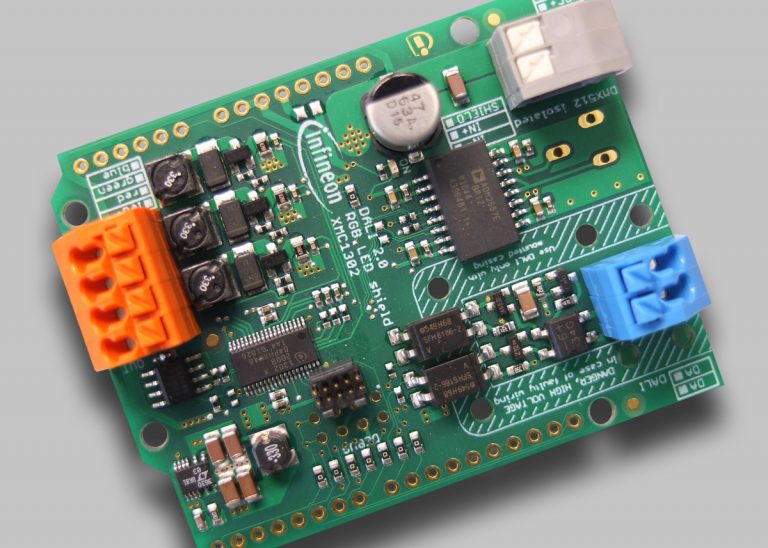
The RGB LED lighting shield is compatible with Arduino as well as Infineon’s XMC1100 boot kit. It is easily configurable for various LED light engines and lamps, allowing for fast prototyping and cheap evaluation of LED lighting designs. 

The RGB LED lighting shield based on the XMC1302 microcontroller uses a dc-dc buck converter topology, and can drive up to three LED channels with a constant current. The shield’s XMC1302 MCU features an embedded brightness color control unit (BCCU) for flicker-free LED dimming and color control. 

The BCCU enables low-cost but high-quality LED lighting solutions, with minimal need for code generation. The RGB LED lighting shield also provides options for the evaluation of smooth, eye-friendly dimming and color mixing for various topologies

STMicroelectronics

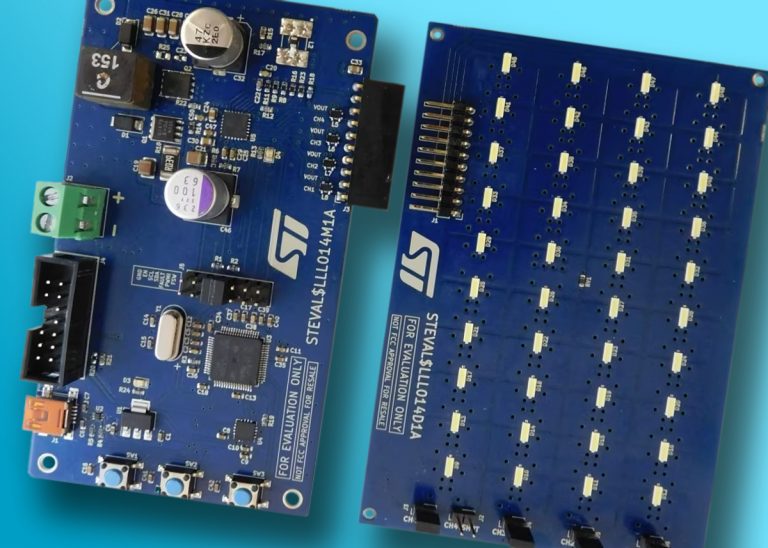
The STEVAL-LLL014V1 evaluation kit features the SPC582B60E1 32-bit automotive-grade microcontroller for controlling the ALED7709 LED driver via an I2C interface. The main board can be configured and controlled via a Mini-USB connection to a PC running the STSW-LLL014GUI software. The kit also includes an LED board with four strings of 10 LEDs. 

STMicroelectronics

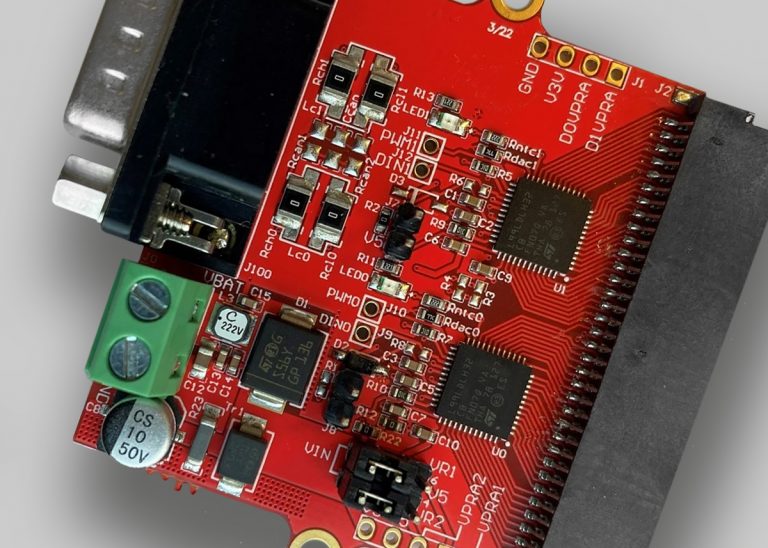
The EV-L99LDLH32GEN board provides a way to connect the L99LDLH32 multi-channel automotive LED driver to an existing system. To connect a lighting load, it is necessary to design a specific adapter board suited to the chosen OLED panel.

Microchip

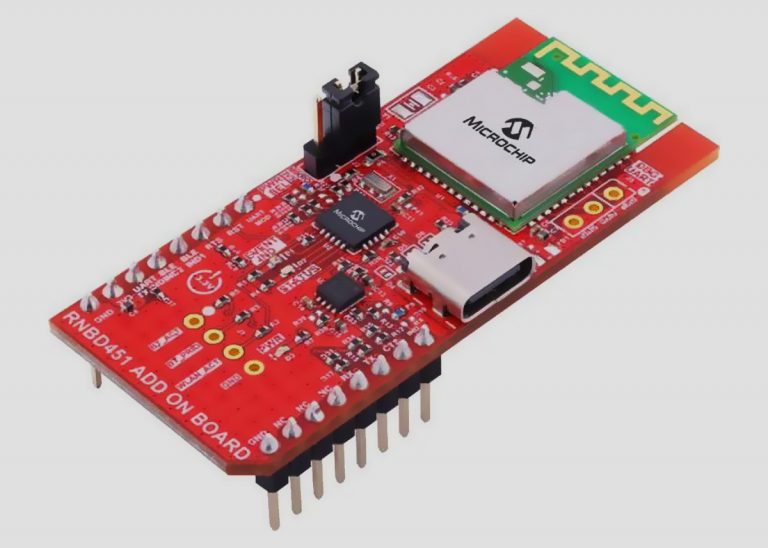
The RNBD451 Add-On Board is an efficient, low-cost development platform based on the RNBD451PE Bluetooth® Low Energy module from Microchip. 

The board complies with the mikroBUS™ add-on bus standard. It also includes an on-board MCP2200 USB-to-UART converter, enabling out-of-the-box evaluation with no other hardware requirements.

The RNBD451 Add-On Board supports a wide range of applications:

  • Wireless lighting
  • Home automation
  • IoT devices
  • Industrial automation
  • General-purpose Bluetooth data exchange