
Infineon

AI evaluation kit targets inference and always-on workloads on PSOC™ Edge E84

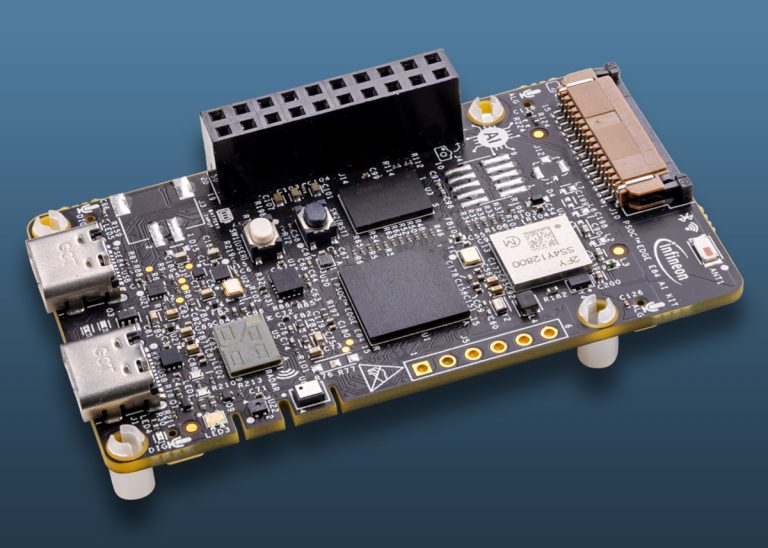
The KIT_PSE84_AI evaluation kit is intended for assessment of artificial intelligence and machine learning workloads on the Infineon PSOC™ Edge E84 microcontroller. The board is configured to demonstrate the interaction between the high-performance compute domain, based on the Arm® Cortex®-M55 with Ethos™-U55 NPU, and the low-power always-on domain, which combines a Cortex-M33 core with Infineon’s NNLite neural network accelerator.

The platform supports evaluation of common edge AI use cases such as acoustic activity detection, voice processing, and sensor-based inference. Audio interfaces, sensor connectivity, including 60GHz radar and pressure sensors as well as memory access are provided to allow execution of neural network models across shared SRAM and non-volatile RRAM resources. This enables analysis of task partitioning, power-domain interaction, and inference latency under representative operating conditions.

The kit is supported by the ModusToolbox™ development environment and integrates with DEEPCRAFT™ Studio tooling for model deployment and validation. It is intended for engineers evaluating AI-enabled embedded architectures where low-power, always-on inference and higher-performance processing must operate within a single device.
Infineon

Evaluation board supports AI and HMI development on PSOC Edge E84

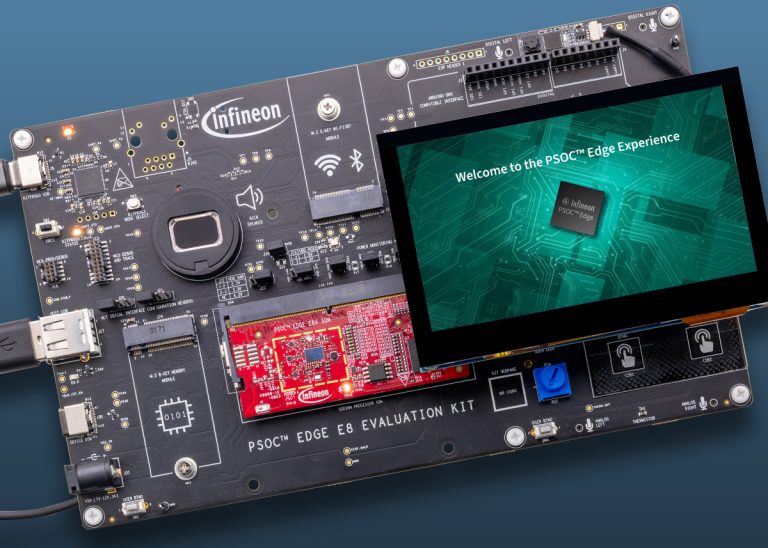
The KIT_PSE84_EVAL evaluation board provides a hardware platform for assessing the capabilities of the Infineon PSOC Edge E84 microcontroller in AI-enabled embedded systems. The board exposes both the high-performance and low-power compute domains, allowing evaluation of workloads that combine neural network inference, signal processing, and real-time control.

The evaluation board supports development of always-on AI use cases by enabling interaction between the Cortex®-M55 with Ethos™-U55 NPU and the low-power Cortex-M33 with NNLite accelerator. Memory resources are accessible to demonstrate shared SRAM and non-volatile RRAM usage across compute domains. Interfaces for audio, display, sensors, and communication peripherals allow investigation of voice, graphics, and HMI workloads under representative system conditions.

Debug and programming interfaces support firmware development and analysis using the ModusToolbox™ software environment, with compatibility for AI workflows using DEEPCRAFT™ Studio. The board is intended for evaluation of edge AI, low-power inference, and multi-core task partitioning in consumer, industrial, and security-focused applications.

Littelfuse

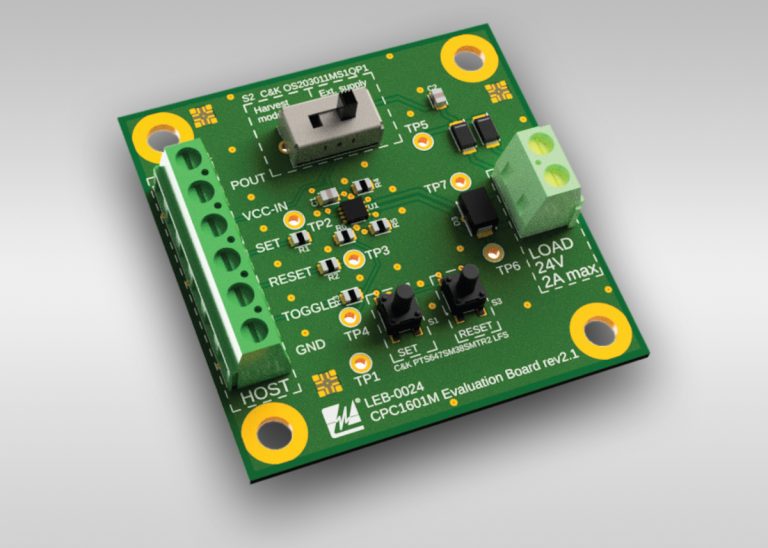
The LEB-0024 evaluation board for the CPC1601M from Littelfuse includes on-board switches and a mode selector, allowing easy hands-on testing of the relay either manually or via external control signals. 

The kit features manual load switching via built-in tactile push-buttons, external control input pins for driving the relay from a microcontroller or logic, and a slide-switch to select an external supply or load-powered mode. The board includes a test pin to power external components up to 10mW, and over-voltage protection with a transient voltage suppression diode for the relay outputs.

The LEB-0024 board provides a ready-made platform to evaluate the CPC1601M latching and energy-harvesting capabilities.

STMicroelectronics

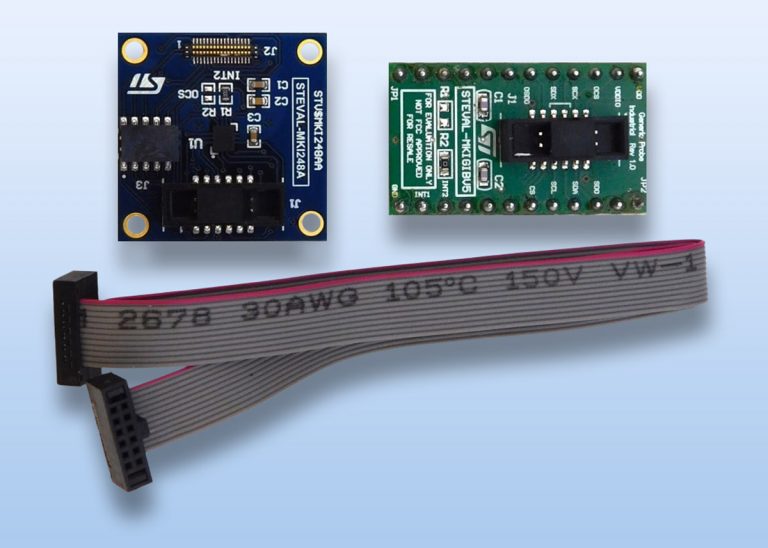
The STEVAL-MKI248KA kit from STMicroelectronics consists of a generic DIL24 adapter board, the STEVAL-MKIGIBV5, a flat cable, and a square PCB on which is mounted the ISM6HG256X six-axis IMU.

The sensor is soldered precisely in the center of the square PCB, making it easy to mount the board on prototype equipment.

STEVAL-MKIGIBV5 board can be plugged into a standard DIL-24 socket. The kit supports the complete ISM6HG256X pin-out, and comes ready to use with the required decoupling capacitors on the power-supply line.

The kit is complemented by the STEVAL-MKI109D evaluation platform, which includes a high-performance 32-bit microcontroller: this functions as a bridge between the sensor and a PC, on which engineers can use the downloadable MEMS Studio graphical user interface, or dedicated software routines for custom applications.

STMicroelectronics

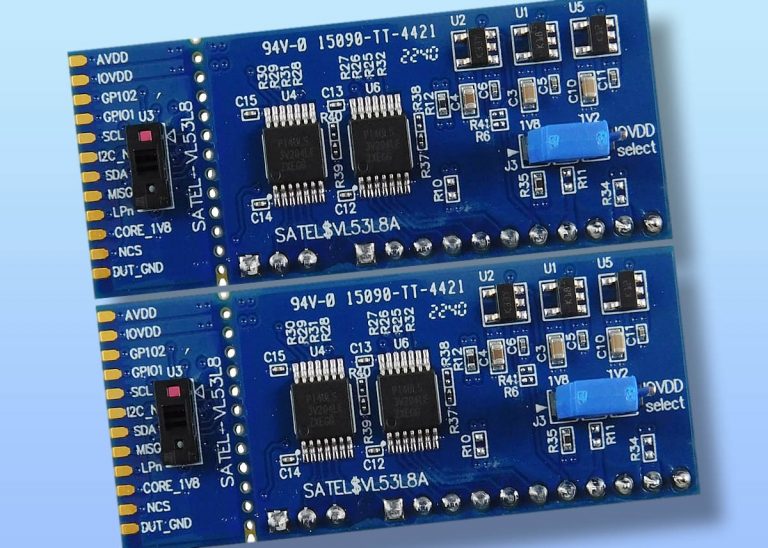
The SATEL-VL53L8 package for the VL53L8 family of time-of-flight (ToF) sensors from STMicroelectronics includes two breakout boards which can easily be integrated into a customer’s devices.

The PCB section which includes the VL53L8 ToF sensor module is perforated. The developer can break off the mini-PCB and use it in an application with a 3.3V supply via flying wires. It is easy to integrate the SATEL-VL53L8 breakout boards into devices under development thanks to their small size.

The breakout boards support two products in the VL53L8 family, the VL53L8CX and VL53L8CH 8×8 multi-zone ToF ranging sensors. They are compatible with the X-NUCLEO-53L8A1 ToF expansion board.

STMicroelectronics

The STEVAL-MKI207V1 is an adapter board designed to facilitate the evaluation of the ISM330DHCX inertial measurement unit (IMU) for industrial applications in the MEMS product portfolio. The board offers an effective solution for fast system prototyping and device evaluation directly within the user’s own application.

The STEVAL-MKI207V1 can be plugged into a standard DIL24 socket. The adapter provides the complete ISM330DHCX pinout and comes ready to use with the required decoupling capacitors on the VDD power supply line. This adapter is supported by the STEVAL-MKI109D evaluation platform with a high-performance 32-bit microcontroller functioning as a bridge between the sensor and a PC, on which it is possible to use the downloadable MEMS Studio graphical user interface or dedicated software routines for customized applications.

  • Complete ISM330DHCX pinout for a standard DIL24 socket
  • Fully compatible with the STEVAL-MKI109D evaluation platform
1 2 3 10