
Infineon

AI evaluation kit targets inference and always-on workloads on PSOC™ Edge E84

The KIT_PSE84_AI evaluation kit is intended for assessment of artificial intelligence and machine learning workloads on the Infineon PSOC™ Edge E84 microcontroller. The board is configured to demonstrate the interaction between the high-performance compute domain, based on the Arm® Cortex®-M55 with Ethos™-U55 NPU, and the low-power always-on domain, which combines a Cortex-M33 core with Infineon’s NNLite neural network accelerator.

The platform supports evaluation of common edge AI use cases such as acoustic activity detection, voice processing, and sensor-based inference. Audio interfaces, sensor connectivity, including 60GHz radar and pressure sensors as well as memory access are provided to allow execution of neural network models across shared SRAM and non-volatile RRAM resources. This enables analysis of task partitioning, power-domain interaction, and inference latency under representative operating conditions.

The kit is supported by the ModusToolbox™ development environment and integrates with DEEPCRAFT™ Studio tooling for model deployment and validation. It is intended for engineers evaluating AI-enabled embedded architectures where low-power, always-on inference and higher-performance processing must operate within a single device.

Infineon

Evaluation board supports AI and HMI development on PSOC Edge E84

The KIT_PSE84_EVAL evaluation board provides a hardware platform for assessing the capabilities of the Infineon PSOC Edge E84 microcontroller in AI-enabled embedded systems. The board exposes both the high-performance and low-power compute domains, allowing evaluation of workloads that combine neural network inference, signal processing, and real-time control.

The evaluation board supports development of always-on AI use cases by enabling interaction between the Cortex®-M55 with Ethos™-U55 NPU and the low-power Cortex-M33 with NNLite accelerator. Memory resources are accessible to demonstrate shared SRAM and non-volatile RRAM usage across compute domains. Interfaces for audio, display, sensors, and communication peripherals allow investigation of voice, graphics, and HMI workloads under representative system conditions.

Debug and programming interfaces support firmware development and analysis using the ModusToolbox™ software environment, with compatibility for AI workflows using DEEPCRAFT™ Studio. The board is intended for evaluation of edge AI, low-power inference, and multi-core task partitioning in consumer, industrial, and security-focused applications.

Infineon

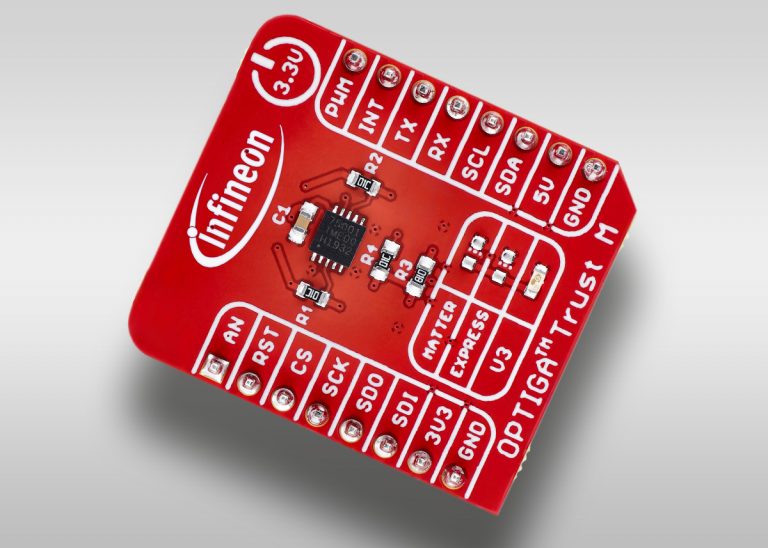
The OPTIGA™ Trust M Express Shield from Infineon provides a convenient way to evaluate the OPTIGA Trust M Express family of discrete secure elements. 

It is supplied in a popular mikroBus™ format which makes it easy to integrate into prototype systems based on any microcontroller or microprocessor platform. The shield board can also be used with single-board computers when supported by the appropriate adapters. 

The OPTIGA Trust M Shield is compatible with the Infineon PSOC™ 62S2 Wi-Fi BT Pioneer Kit and OPTIGA Trust Adapter.

Features of the shield board include:

  • Pre-provisioned TLS security certificates
  • CC EAL 6+ certified hardware
  • Qwiic compatible
  • I2C interface with shielded connection
  • Cryptographic toolbox
  • Supports multiple cryptographic algorithms:

ECC, RSA, AES, HMAC, HKDF, TLS PRF

Infineon

REF_60W1_ZVS_186EM is a 60 W auxiliary power supply reference design based on Infineon’s latest CoolSET™ SiP ICE186EM configured in a flyback topology.

Infineon

The EZ-USB™ FX20 Development Kit is a hardware and software development platform for the CYUSB4022-FCAXI, an EZ-USB FX20 USB peripheral controller which supports data-transfer rates up to 20 Gbits/s. 


Infineon

The Infineon OPTIGA™ TPM SLB 9673 RPI evaluation board for Raspberry Pi provides a quick and easy way for developers to get started on security system design with the OPTIGA TPM SLB 9673 trusted platform module (TPM). 


1 2 3 11