
Consumer
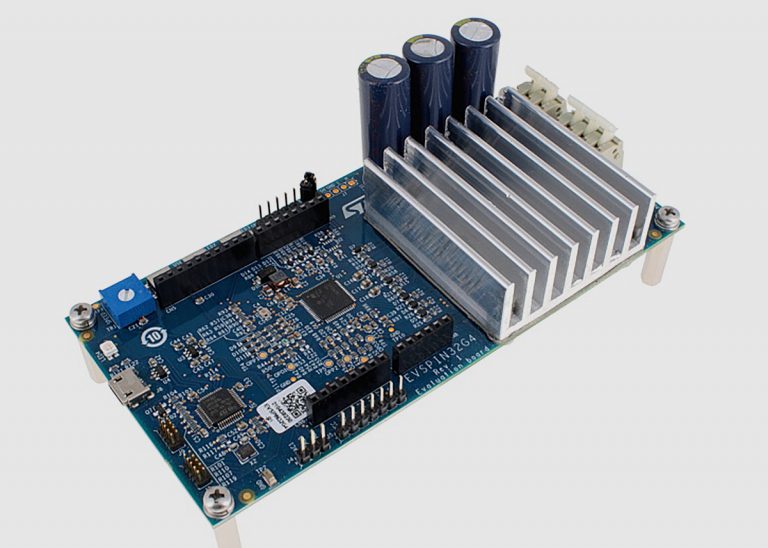
The EVSPIN32G4 and EVSPIN32G4NH are demonstration boards based on the STSPIN32G4 SiP and STL110N10F7 power MOSFETs. The boards support three- or single-shunt configurations, and can run both sensorless and sensored control algorithms.
The integrated operational amplifiers for current sensing, the drain-source voltage sensing at each power MOSFET, and comparators for over-current protection make this a fully integrated solution for motor control.
Thanks to the integrated voltage regulators, both the gate driver and control logic supplies can be generated from the motor supply without dedicated circuitry. The board is intended to drive three-phase brushless dc (BLDC) motors in applications such as power tools, e-Bikes, fans, and home appliances.
A connector enables the EVSPIN32G4 to be interfaced with expansion boards, such as MEMS sensors or Bluetooth® transceivers. The on-board ST-LINK/V2 programmer speeds up and simplifies the debugging of microcontroller firmware.
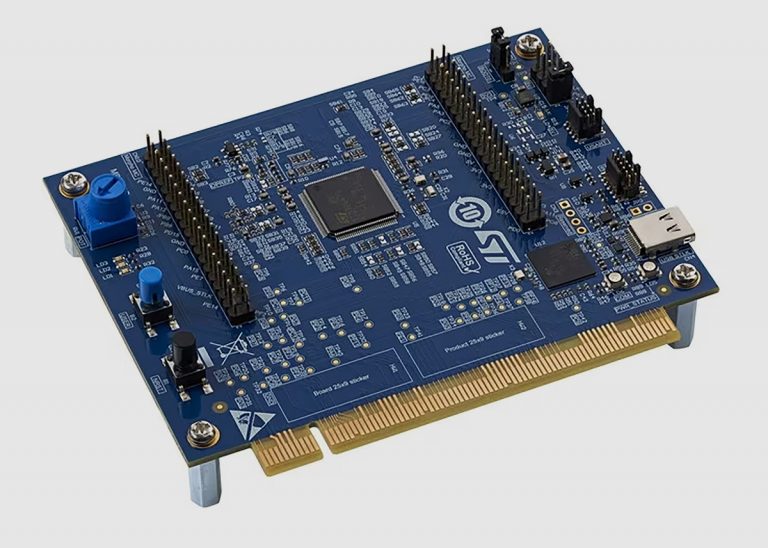
The B-G473E-ZEST1S Discovery kit, a part of the STMicroelectronics motor-control development platform, supports the ZeST and HSO algorithms.
The B-G473E-ZEST1S is a control board featuring a STM32G473QET6 microcontroller in a ZeST Discovery pack. It works with a power board such as the STEVAL-LVLP01, an optional adaptor board such as the B-ZEST-ADAPT1, and an accessories package such as the B-MOTOR-PMSMA1.
The B-G473E-ZEST1S control board is connected to the power board or adaptor board through an embedded V2 motor-control connector. The board can also operate with the X-NUCLEO-IHM08M1, X-NUCLEO-IHM09M1, or X-NUCLEO-IHM16M1 motor-driver expansion boards via a Morpho motor-control connector.
The board includes an integrated STLINK-V3EC in-circuit debugger and programmer.
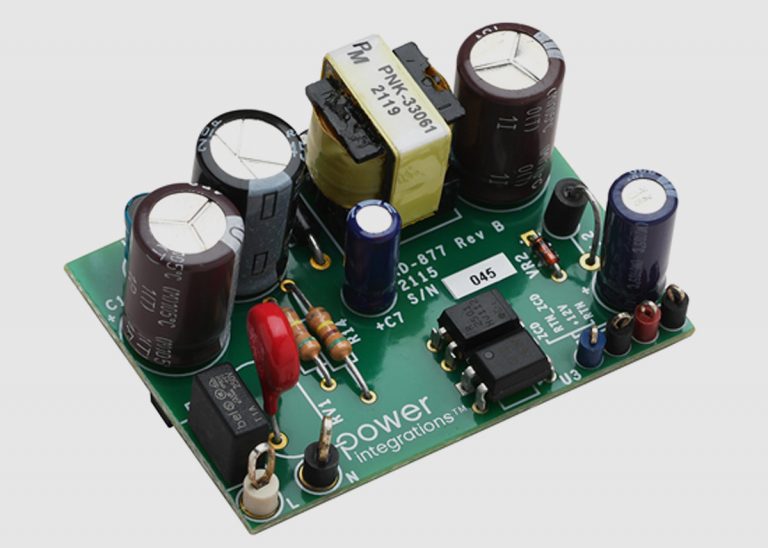
The RDK-877 reference design describes an isolated flyback converter which provides a nominal output voltage of 12 V at 0.5 A load from a wide input-voltage range of 90 V to 305@nbsp;V ac, as well as an isolated zero-crossing detection signal.
This power supply uses the LNK3306D from the LinkSwitch-TNZ family of ICs. The kit contains the complete power-supply specifications, bill-of-materials, transformer construction, circuit schematic and PCB layout, along with performance data and electrical waveforms.
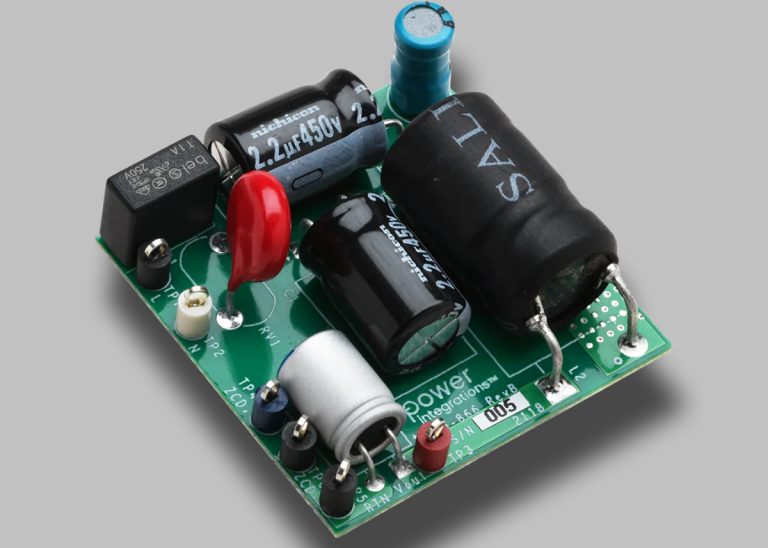
The RDK-866 reference design describes a non-isolated buck converter power supply with an input-line zero-crossing detection output signal. The nominal output is 5 V/500 mA across the input range of 90 V to 300 V ac.
The system is powered by the LinkSwitch-TNZ IC controller. The LinkSwitch-TNZ family of ICs combines power conversion with lossless generation of an ac zero-crossing signal used typically for system clock and timing functions. The device incorporates a 725 V power MOSFET, oscillator, a high-voltage switched current source for self-biasing, frequency jittering, fast (cycle-by-cycle) current limit, hysteretic thermal shutdown, and output and input overvoltage protection circuitry in a monolithic IC.
Designs using the highly integrated LinkSwitch-TNZ ICs are more flexible than discrete implementations, reducing component count by 40% or more. The key design goal is low cost, low audible noise and compact form factor for use in wireless and relay power supplies.
The OPTIGA™ Trust M IoT Security Development Kit is the easiest way to develop and evaluate end-to-end security use cases for IoT devices. The kit enables designers to build prototypes of security applications and build full-featured IoT applications. The board includes:
- OPTIGA Trust M security solution
- PSOC™ 62, an Arm® Cortex®-M4/Cortex-M0+-based microcontroller
- AIROC™ CYW43012, a low-power system-on-chip which supports dual-band 2.4 GHz and 5.0 GHz Wi-Fi®/Bluetooth® 5.0 networking
This development board is supplied with two ready-to-use security use cases:
- Secured communication with AWS over MQTT using cryptography support from the OPTIGA Trust M
- Secure, zero-touch cloud provisioning using a CIRRENT™ Cloud ID and the pre-provisioned X.509 certificate delivered with the OPTIGA Trust M
The kit is supported by the ModusToolbox™ design tool. The OPTIGA Trust M host library is available as open source code.